
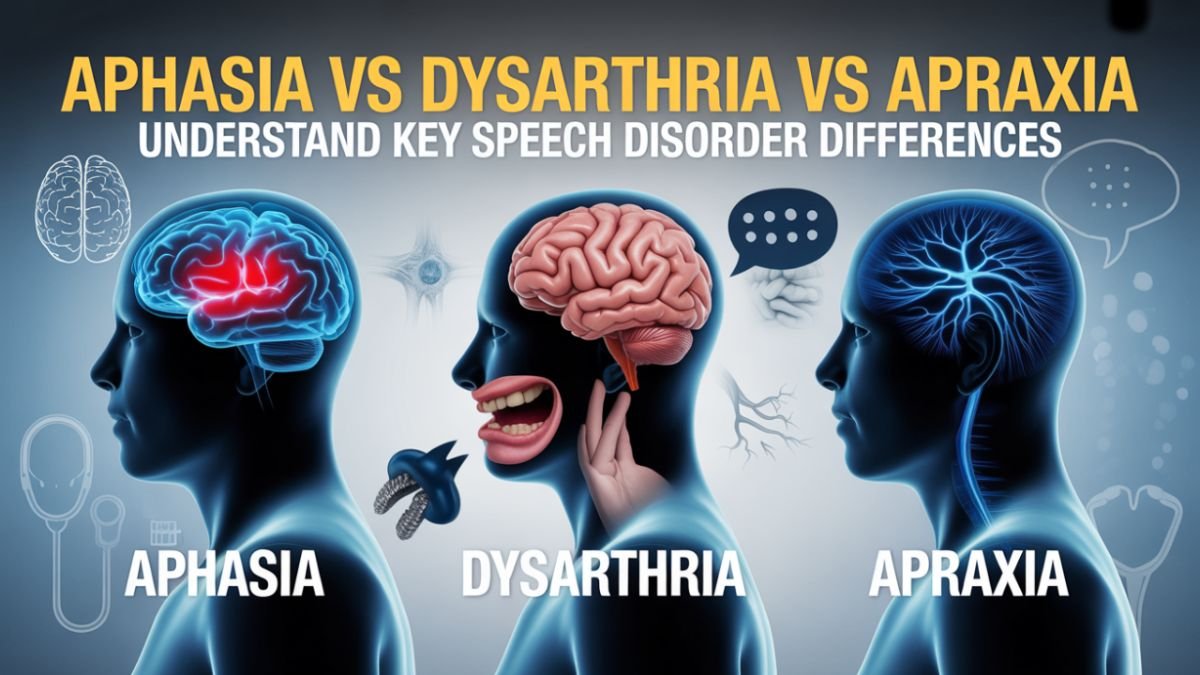
Language and the ability to speak are among the most important aspects of human life. But when a person has difficulty speaking, understanding, or pronouncing words, it’s not just a “communication problem”—it also profoundly impacts their self-confidence, social life, and mental health. This is where terms like “Aphasia,” “Dysarthria,” and “Apraxia” come into play. These three are all speech disorders, but they differ in their nature, causes, and symptoms. In this article, we will understand in detail the differences between Aphasia, Dysarthria, and Apraxia, their causes, and how they are treated.
What is Aphasia?
Aphasia is a language disorder that is usually caused by damage to the “language center” of the brain. This damage can be due to a stroke, head injury, tumor, or neurological disease (such as Alzheimer’s or Dementia).
In Aphasia, a person may have difficulty with all four aspects of language: speaking, listening, reading, and writing. Some people can understand what is being said but cannot respond, while others can speak but cannot understand what others are saying.
Main types of Aphasia:
- Broca’s Aphasia (Non-fluent Aphasia): The person has difficulty speaking words, but can understand what others are saying.
- Wernicke’s Aphasia (Fluent Aphasia): The person speaks easily, but what they say is not clear in meaning. They also have difficulty understanding what others are saying.
- Global Aphasia: This is the most severe form of Aphasia. In this, the person has no ability to speak, understand, read, or write.
- Anomic Aphasia: In this, the person has difficulty recalling the correct words. They know what they want to say, but the words don’t come to mind.
What is Dysarthria?
Dysarthria is a speech disorder in which the muscles (of the tongue, lips, face, and throat) do not function properly. This is caused by damage to the brain or nervous system In dysarthria, a person has difficulty pronouncing words correctly. Speech may be slow or very fast, the voice may be slurred, and the tone or volume of the voice may be reduced.
Causes of Dysarthria:
- Stroke
- Head Injury
- Parkinson’s disease
- Multiple Sclerosis (MS)
- Amyotrophic Lateral Sclerosis (ALS)
- Cerebral Palsy
- Symptoms of Dysarthria:
- Slurred or mumbled speech
- Shortness of breath while speaking
- Nasal-sounding voice
- Speaking in a monotone
- Speaking too slowly or too quickly
It’s important to note that in dysarthria, the person understands and can think in language, but the muscles of their mouth are unable to form the words correctly.
What is Apraxia?
Apraxia is a motor speech disorder that results from damage to the part of the brain that controls the movements of speech. It is a disorder related not to language itself, but to the brain’s “planning system.”
In apraxia, a person has difficulty understanding how to form words. They know what they want to say, but the correct “message” doesn’t reach the muscles of their mouth from the brain.
Types of Apraxia:
Childhood Apraxia of Speech (CAS): This is found in children, where there is a lack of coordination between the brain and the mouth during the language development process.
Acquired Apraxia of Speech: This occurs in adults, usually after a stroke or brain injury.
Symptoms of Apraxia: Repeated attempts to pronounce words
Inconsistent pronunciation each time
More difficulty pronouncing longer words
Taking pauses during speech
Emphasizing the wrong syllables
Treatment Methods for These Disorders
- Speech Therapy: This is the most effective method. Specialists (Speech-Language Pathologists) conduct specific exercises tailored to the individual’s condition, such as repeating words, identifying pictures, creating word sequences, etc.
- Occupational Therapy: This teaches the individual to regain independence in daily life activities.
- Physical Therapy: In cases of Dysarthria, it helps strengthen the muscles of the face and mouth.
- Technology-based Therapy: Nowadays, many digital apps, speech software, and virtual assistants are being used in treatment.
- Family and Social Support: Encourage the patient to speak, be patient, and avoid completing their sentences for them. This emotional support is very important in the treatment process.
Emotional and Social Impact
Speech disorders are not just a medical problem; they deeply affect a person’s self-confidence, social life, and mental health. Individuals suffering from Aphasia or Apraxia have difficulty expressing their emotions, which can lead to depression or social isolation In such cases, the support of family and friends is crucial. Appreciating small achievements, maintaining eye contact while talking, and being patient play a significant role in boosting the patient’s self-esteem.
Conclusion:
Aphasia, Dysarthria, and Apraxia although all three are speech-related problems, their effects, causes, and treatments are different. Aphasia affects language, Dysarthria affects the muscles of speech, and Apraxia affects the brain’s planning system Timely and accurate diagnosis, expert supervision, and family support – these three things can play a vital role in helping any individual return to a normal life.
