
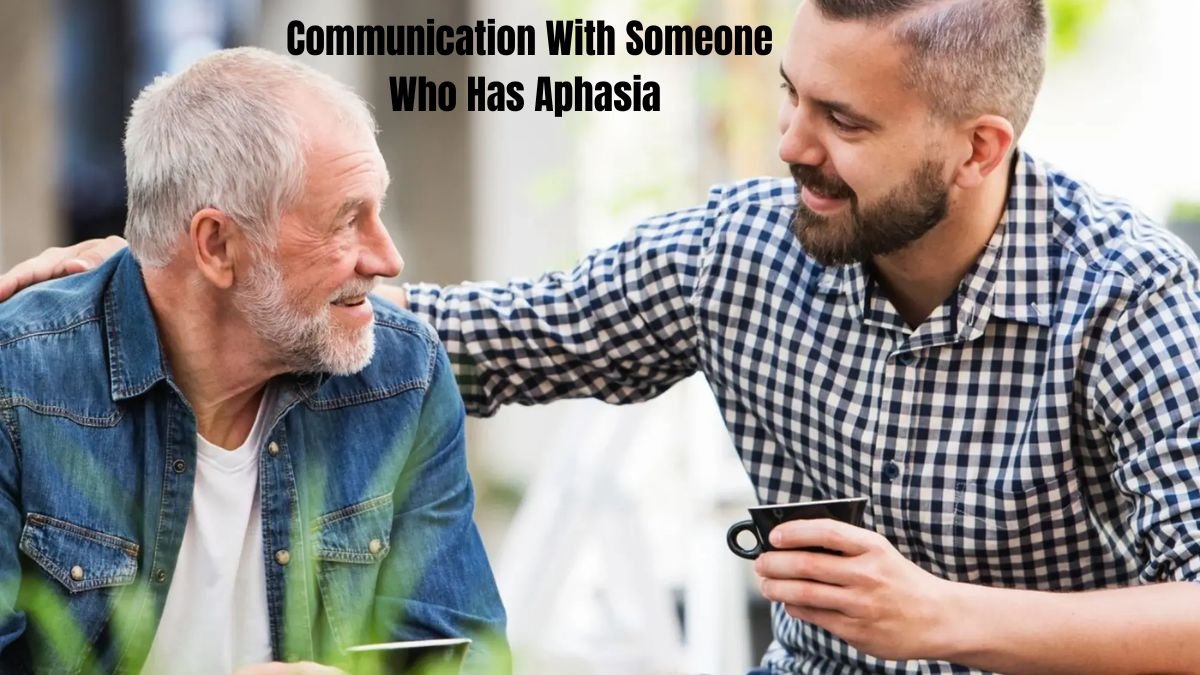
Aphasia is a neurological condition that affects a person’s ability to speak, understand, read, or write. This problem usually arises due to injury or a stroke in the brain’s “language centers.” Sometimes, this condition is so severe that the person completely stops speaking, while in other cases, they only have difficulty putting words in the correct order or finding the right words. Therefore, aphasia is not just a linguistic problem — it also deeply affects the person’s emotions, self-confidence, and social connections.
Be Patient – The Greatest Power in Communication
The most important thing when communicating with a person with aphasia is patience.
You may have to repeat the same thing several times, sometimes their answers will be incomplete, or they will use the wrong words.
In such situations, instead of showing impatience or irritation, adopt a calm and encouraging demeanor.
Your calm nature will make them feel safe, and they will continue to try to speak.
Example: If the person is unable to say something, give them plenty of time.
Never interrupt or try to complete their sentences for them.
Use Simple and Clear Language
Complex sentences can be difficult for a person with aphasia to understand.
Therefore, when speaking, use short, direct, and clear sentences.
Incorrect way: “If you want, we can go for a walk in the park this evening, or if the weather is bad tomorrow, we might stay home.”
Correct way: “Shall we go to the park today?“If it rains, we will stay home.”
Such short sentences are not only easier to understand but also make it easier to respond.
Use Non-verbal Cues
Sometimes, facial expressions, gestures, and pictures are more helpful than words. Using hand gestures, pointing to objects, or using pictures helps the person understand the message.
Example: If you want to ask, “Do you want some water?”, show a glass of water and say, “Water?”
This type of visual aid makes the recognition process easier for the person’s brain.
Listen and respond carefully
The words of a person struggling with aphasia are not always clear.
Sometimes they will say one word, but mean something else Therefore, try to understand not only their words, but also their tone of voice, facial expressions, and gestures.
Communicate in a familiar environment
A person with aphasia finds it easier to communicate in a calm and familiar environment They can easily become confused in noisy, crowded, or stressful environments Therefore, choose a place for conversation where there is less noise and fewer distractions A quiet room at home, a corner of a park, or a hospital consultation room – these are better options.
Use Visual Aids
Many therapists recommend using picture cards, written words, or mobile apps for aphasia patients These tools are extremely helpful in understanding and practicing communication
- Cards with pictures of food, water, medicine, and family members
- “Speech therapy apps” on a phone or tablet, such as Constant Therapy or Lingraphica
- These types of visual aids help the individual recognize and connect with words.
Create a Positive Environment
- Individuals with aphasia often feel frustrated or embarrassed because they feel they cannot communicate in a “normal” way.
- Therefore, praise and encourage them for every small step of progress.
- “That was very well said!”
- “Your answer was absolutely correct!”
- “Look, you are getting better every day.”
- Such small phrases strengthen their confidence and motivate them to continue practicing.
Seek Help from a Speech Therapist
If someone in your family has aphasia, it is crucial to contact a Speech and Language Pathologist (SLP).
They create specialized therapy plans tailored to the individual’s condition —
such as word recall exercises, reading and speaking training, and “communication training” for the family.
Under the guidance of a therapist, communication becomes more effective and positive.
Utilize Technology
Today, there are many mobile apps and online tools that assist aphasia patients These apps make the process of speaking, recognizing words, and forming sentences easier.
Some popular apps:
- Lingraphica TalkPath Therapy – for communication and word practice
- Constant Therapy – to track individual progress
- Tactus Therapy – to work on both speech and memory
Family members should use these apps together, so that communication becomes a game or a fun activity.
Maintain Empathy and Emotional Connection
Communication is not just the exchange of words it is a connection from heart to heart. A person with aphasia needs understanding and empathy more than words When you reassure them with a smile, a touch, or eye contact, they feel that they are still being heard and understood And this feeling gives them the greatest encouragement to speak and connect.
Conclusion – A New Language of Communication
Communicating with someone who has aphasia is not an impossible task. A little patience, a little understanding, and a lot of love can give communication a new direction. When a smile replaces every word, a gesture replaces every sentence, and heartfelt understanding replaces every silence, that becomes the true art of communicating with a person suffering from aphasia. Their voice may be soft, but their heart speaks – we just need to learn to listen.
